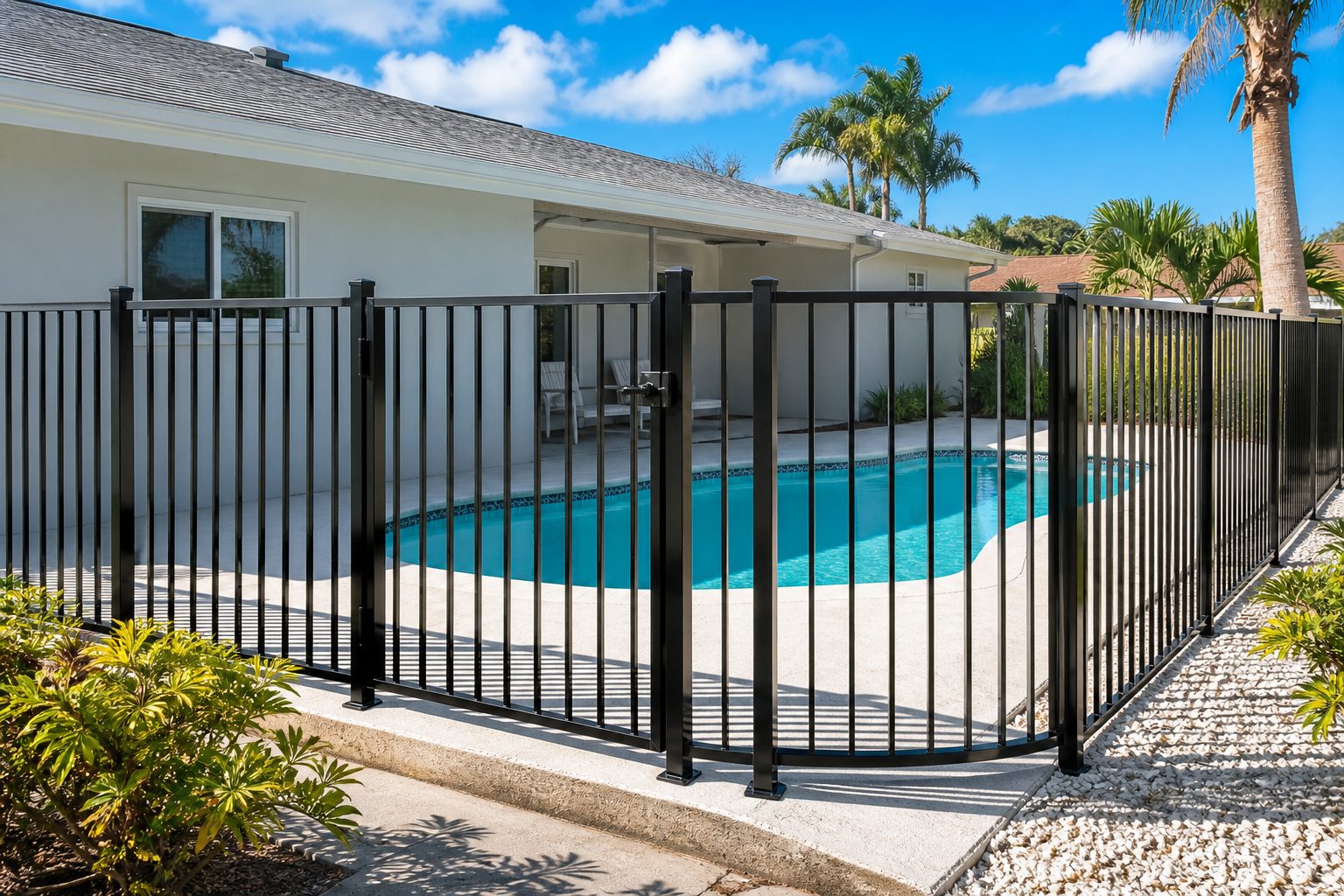
A pool fence in Broward is not a style choice first. It is a barrier. Florida law and the Florida Building Code treat it that way, and so do the inspectors in Pompano Beach and Deerfield Beach.
Today is August 26, 2026. Hurricane season is still on, and a lot of the pool-fence calls we get this month are the same two jobs: a new aluminum run around a pool that just got a CO, or an older gate that stopped self-closing after wind and rain. EPR Fencing & Pergolas is based in Pompano Beach. We are licensed, insured, and veteran-owned. Aluminum is the material we install most often when the fence has to meet residential swimming-pool barrier rules and still look like it belongs on a coastal lot.
If you are comparing materials, start with our aluminum fence installation page and the aluminum vs. vinyl write-up. Vinyl wins on privacy. Aluminum wins around water.
We are not the building department and we are not your HOA. What follows is how we spec and install pool-grade aluminum in Pompano Beach and Deerfield Beach so the barrier actually works, height, openings, gates, salt, and the details that fail inspection.
What “pool-code” means on a Broward lot
Florida’s Residential Swimming Pool Safety Act (Chapter 515) and the Florida Building Code residential pool chapter both describe a barrier, not a decorative railing. The points we design to on a typical single-family pool:
- Height. The top of the barrier is at least 48 inches above grade on the side facing away from the pool. We measure from finished grade, not from the top of a footer or a raised planter.
- Bottom gap. Clearance under the fence is tight, the code maximum is 2 inches from grade to the bottom of the barrier on the outside. A washout after a storm that opens that gap is a code problem, not just a cosmetic one.
- Openings. Nothing in the barrier can pass a 4-inch sphere. On aluminum that is picket spacing, not a suggestion. We set pickets so a toddler cannot squeeze through.
- Climbability. Horizontal rails, decorative scrolls, and anything a child can use as a ladder are the usual failures. Vertical pickets with the right rail heights are why aluminum is the default pool fence here.
- Gates. Pool gates open out, away from the water. They self-close and self-latch. The release is on the pool side, placed so a young child cannot reach it over the top or through a gap. Where the release is at least 54 inches from the bottom of the gate, code allows it on either side, that is the hardware we use on most residential aluminum gates. Openings within 18 inches of the latch are limited.
- The house wall. If a door from the house opens to the pool, that door is part of the barrier conversation. Alarms and self-closing hardware on those doors are a separate item from the fence. We will flag it. We do not pretend a pretty aluminum run fixes an unlatched slider.
Cities and the county can add paperwork. Product approval or signed-and-sealed drawings for aluminum systems are normal in our High-Velocity Hurricane Zone. We handle that packet on a new install. A weekend gate closer from a big-box store is not a pool-code repair.
Why aluminum is the usual pool fence in Pompano Beach and Deerfield Beach
Wood privacy and vinyl privacy have their place on a side yard. Around a pool they fight the barrier rules. Solid panels can be climbable. Wood swells, rot starts at grade, and a gate that bound last August will not self-close this August. Vinyl gates are heavy; a shifted hinge post makes them miss the latch.
Aluminum does the job we actually need:
- Vertical pickets at code spacing without looking like chain link
- Powder-coated finish that holds UV and, with the right alloy and hardware, salt
- Modular sections, so a bent bay comes out without tearing down the whole backyard
- Gates that stay the same size in rain, which is what a closer needs
We still install wood and vinyl on the rest of the property when you want privacy from the street or the neighbor. A common layout in Pompano Beach and Deerfield Beach is aluminum around the water and a privacy run on the street-facing or side-yard line. That is one job for us, not two companies arguing over the property line.
Coastal lots, east of Federal Highway, Hillsboro Beach, Lighthouse Point, the Intracoastal side of both cities, get stainless hinges, latches, and fasteners. Painted steel hardware rusts, the gate sags, and it looks like “the aluminum failed.” It was the hardware.
The gate is the inspection
Inspectors walk the line, then they spend their time on the gate. So do we.
A pool gate that stands open is an open pool. After a squall, the closer is often the only thing wrong. That is a same-day repair if the post is still plumb. If the hinge post rotated in wet soil, no closer in the catalog will save it until the post is reset.
On a new install we:
- Set the hinge post and latch post plumb and in concrete sized for our wind and soil
- Hang a gate that opens out, with a closer and latch that actually catch from a small opening and from a full swing
- Check latch height and the pool-side release
- Confirm the gate cannot be lifted off the hinges when it is closed
- Test it after the concrete has done its job, not only on install day
Double gates for furniture and equipment need at least one leaf that self-closes and self-latches, plus a drop rod or equivalent on the inactive leaf that people actually use. A decorative double gate that is pinned open all summer is not a barrier.
If you already have aluminum and the gate is the problem, that is usually repair, not a full replacement. We repair fences we did not originally install.
Pompano Beach and Deerfield Beach are not the same walk
We are headquartered in Pompano Beach, so Pompano Beach fence installation is home. Cresthaven, Palm Aire, Leisureville, Pompano Isles, the Highlands, and the waterfront runs off Atlantic and A1A all show up on the calendar. Sandy fill, a high water table near the Intracoastal, and salt on anything east of Federal Highway change post depth and hardware. HOAs in Palm Aire and similar communities often care about color and height on anything visible from the street. Pool-code height still wins if the two conflict, we will tell you before we order panels.
Deerfield Beach is a short run north. Cove, Waterway, Century Village, Deer Creek, The Palms, and the neighborhoods around the pier are regular work. Front-yard height in residential zoning is typically capped at 4 feet, which happens to match the pool-barrier minimum. Side and rear yards are often allowed to 6 feet. A 6-foot aluminum pool fence in the backyard is common; a 6-foot front-yard fence is not. Corner lots add visibility triangles. We pull the survey and mark the line. We do not guess from the neighbor’s fence.
Both cities want a permit for a new pool barrier. Like-for-like hardware on a permitted fence is a different conversation. Anything that changes height, gate swing, or the barrier layout should be treated as code work.
What we look at on a site visit
A photo of a catalog panel does not tell us if your yard will pass.
- Grade. A slope along the fence line is where bottom-gap failures live. We step the sections or adjust the bottom rail. We do not leave a 5-inch triangle under a panel because the lawn pitches toward the lake.
- Planters, AC pads, and pool equipment. Anything stacked or built next to the outside of the fence can turn a 48-inch barrier into a climbable wall. Move the foothold or raise and spec the fence. Do not hide a code issue behind a ficus.
- Landscaping against the pickets. Hedges and stacked stone on the outside of a pool fence are a climbability problem. If the planting needs a reset, our landscaping crew at EPR Landscaping can look at it at (954) 461-8466. Same company, different trade.
- Existing screens and cages. A screen enclosure is not automatically a legal barrier. Mesh, doors, and latch hardware have their own rules. We will tell you if the aluminum fence is doing work the cage is not.
- Pet doors, puppy pickets, and decorative rings. Cute until it fails the 4-inch sphere or becomes a foothold. We can do pet mesh and tighter picket spacing where it still meets the barrier rules.
- Salt and wind. East-side Pompano Beach and Deerfield Beach lots get more of both. Powder coat grade, post size, and stainless hardware are part of the quote, not an upgrade we mention after the storm.
We do not put prices in this post. Linear footage, gates, engineering, and whether we are matching an older profile all change the number. We walk the property and quote that yard.
Replacing a fence that never was a barrier
A lot of older Pompano Beach and Deerfield Beach pools have a mix: chain link that rusted, wood that rotted at grade, a vinyl section a previous owner added for privacy, and a gate that has been tied open for years. You can sometimes keep a sound run and replace the failing bays. You cannot keep a climbable privacy panel as the pool barrier just because it is already there.
When we replace, we spec current product with Florida product approval or engineer drawings, set posts for HVHZ wind, and hang gates that close. If you want privacy on the neighbor side, we will show you where aluminum has to stay and where vinyl or wood can take over outside the barrier.
Chain link can be built as a barrier with the right mesh, height, and gate hardware. Most homeowners around a residential pool still choose aluminum because it looks like the rest of the street and does not rust in salt air the way old galvanized fabric does.
Permits, HOAs, and what we handle
On a new pool fence in either city we prepare the application, drawings, product approval or engineering, and the survey markup showing height and gates. You should expect an inspection. The inspector will check height, openings, bottom gap, and the gate. Have the closer on and working.
HOAs in parts of Deerfield Beach, Coconut Creek, and the west side of Pompano Beach often want a color, black, bronze, and white are the usual aluminum requests, and they may cap street-facing height. Pool-code still applies inside the yard. We can match an approved style or help you put a change in front of architectural review before we order.
If you are in a flood zone, open picket aluminum is usually the easier conversation than a solid privacy wall. That is a site decision with the survey in hand.
Frequently asked questions
Is a 4-foot aluminum fence enough for a pool in Pompano Beach or Deerfield Beach?
Four feet (48 inches) measured on the outside is the Florida minimum for a residential pool barrier. Many yards go 54 inches or 5 feet for a little more height and a cleaner latch location. Front-yard zoning may still cap you at 4 feet. Taller is not automatically better if it violates the setback or the HOA. We will tell you what that lot can take.
Can I use vinyl or wood around the pool if I add a self-closing gate?
The gate does not fix a climbable barrier. Solid privacy fences often fail because of footholds, horizontal members, or bottom gaps. Aluminum with vertical pickets is the product we recommend when the fence is the pool barrier. Vinyl or wood can still be the right fence on a different line of the same property.
Do you handle the permit?
Yes, on new pool-barrier installs and on replacements that change the fence. A closer swap on an existing permitted gate is usually treated as maintenance; we will say so if we think the city still wants a permit. Pool barriers are not a good place to guess.
Will salt air ruin an aluminum pool fence?
The aluminum itself does not rust the way steel does. Cheap hardware does, and damaged powder coat will chalk and pit if it is left open to salt. We spec stainless hardware on coastal jobs, and we do not try to bend a kinked picket back, we replace the section so the coating stays intact. Wash the fence. Do not pressure-wash the coating off.
Call EPR Fencing & Pergolas
If you need a pool-code aluminum fence in Pompano Beach, Deerfield Beach, or the rest of the east Broward cities we already serve, call (954) 464-9931 or email [email protected]. We will walk the line, check grade and gates, and tell you whether you need a new barrier or a closer and a reset post.
Licensed, insured, veteran-owned. Pompano Beach, FL. Request a visit from the contact page.